
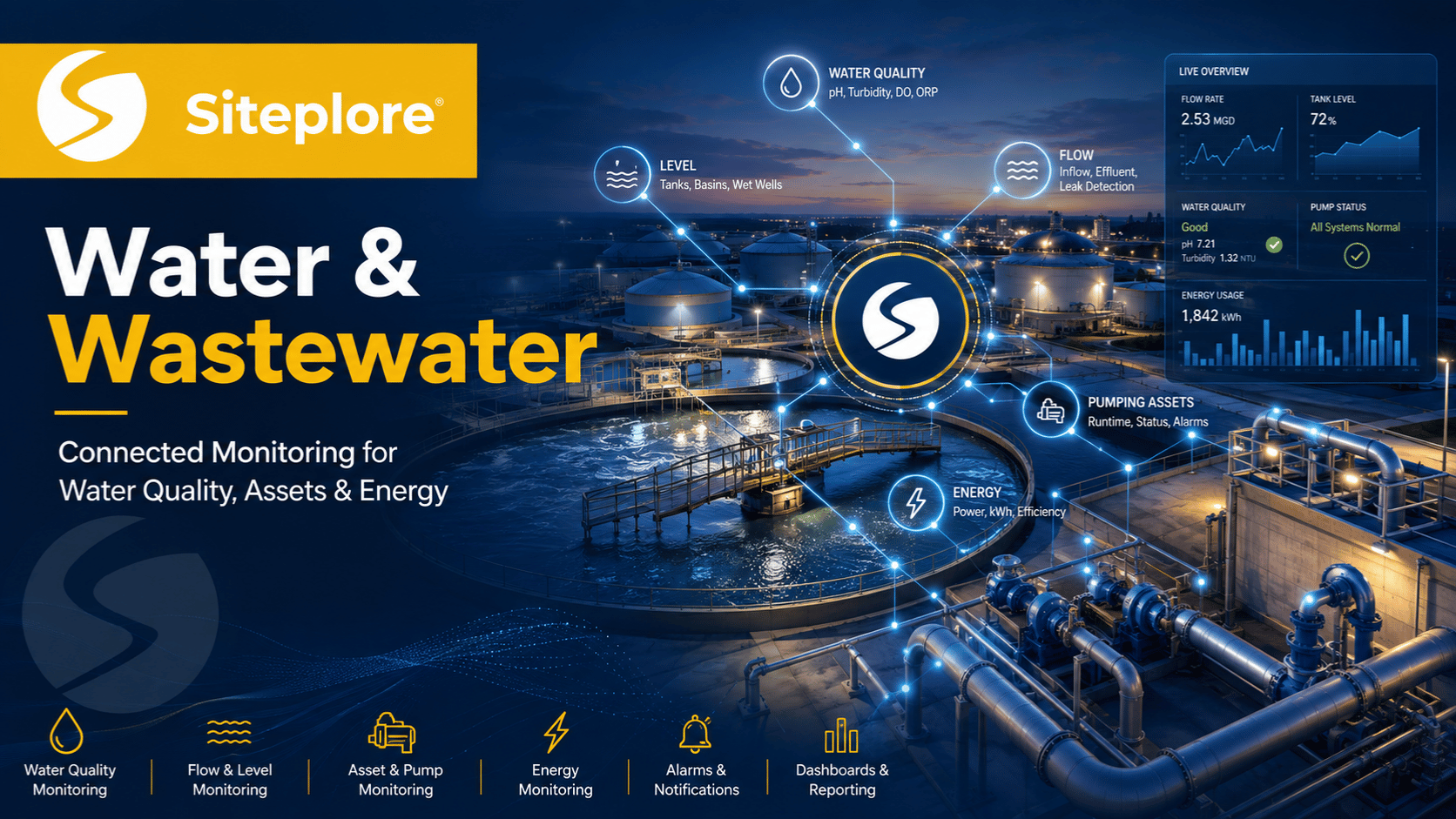
See What Is Happening Across Water, Equipment and Energy.
Siteplore connects selected water-quality, process, pumping, electrical and equipment-condition measurements into one monitoring environment — helping water and wastewater teams build historical visibility, identify developing deviations and prioritize operational and maintenance investigation.
Water systems continuously change. Periodic readings only show part of the story.
Water and wastewater operations depend on the interaction between water condition, hydraulic performance, treatment processes, pumping systems and energy. When those measurements remain distributed across standalone instruments, control systems and manual records, identifying the cause of an abnormal condition can take longer.
Periodic Water-Quality Checks
Important changes may develop between manual sampling or laboratory measurement intervals.
Distributed Pumping Assets
Pumps, booster stations and remote equipment can require physical inspection before condition changes become visible.
Energy Without Pumping Context
Electricity consumption alone may not explain whether changes are related to flow, operating hours or equipment behavior.
Data Across Different Systems
Level, flow, quality and electrical data may exist without one historical view for investigation.
Developing Equipment Problems
Pump, motor or blower condition can change between maintenance inspection intervals.
Data Without Prioritization
More measurements are useful only when they help operators and engineers identify what deserves attention.
Connect water condition, process behavior, equipment and energy under one monitoring architecture.
Water Quality
Connect compatible water-quality instruments into historical monitoring and analytical views.
Level & Storage
Build visibility across selected tanks, reservoirs, sumps and storage systems.
Flow & Pressure
Connect compatible hydraulic measurements to provide process and distribution context.
Pumping Systems
Monitor selected pumps, motors and supporting equipment for operating and condition context.
Energy & Electrical
Understand electrical consumption across selected pumping and treatment equipment.
Treatment & Environmental Context
Connect selected treatment-process and environmental measurements where required.
Measure the parameters that explain what is happening in the water system.
Sensor selection depends on the application, required measurement performance, installation conditions, sample characteristics, maintenance requirements and the operational decision the measurement must support.
pH
Monitor acidity or alkalinity where a suitable online measurement method is applicable.
Dissolved Oxygen
Build historical DO visibility for relevant treatment or water applications.
Conductivity
Monitor compatible conductivity measurements as part of water-condition analysis.
ORP
Add oxidation-reduction potential where it supports the process-monitoring objective.
Turbidity
Monitor selected turbidity trends using instrumentation suitable for the application.
Level
Connect tank, reservoir, sump or other compatible level measurements.
Flow
Add hydraulic context through compatible flow measurement data.
Pressure
Monitor selected pressure points across pumping and distribution systems.
The parameters above represent potential monitoring categories, not guaranteed compatibility or regulatory measurement suitability. Online water instruments may require calibration, cleaning, sample conditioning, consumables, reference checks and application-specific maintenance. These requirements should be defined during engineering.
From water condition to operational context.
Siteplore can combine compatible field measurements, existing instruments and selected system data to create a historical monitoring layer without replacing dedicated process-control functions.
Water Process
Source, treatment, storage, distribution or wastewater process.
Sensors & Instruments
Quality, flow, pressure, level, electrical and condition measurements.
Edge & Integration
Collect compatible data from selected measurement sources.
Siteplore
Dashboards, historical trends, alerts and analytical views.
Operational Decision
Inspection, treatment review, maintenance and optimization investigation.
Water analytics should help teams investigate real operational questions.
Connect water, equipment and energy using the monitoring layer each problem requires.
RekaSense
Connect compatible water-quality, level, flow, pressure and environmental sensors into Siteplore.
Explore RekaSense →PowerWatch
Add electrical and energy visibility across selected pumps, blowers, treatment systems and utility loads.
Explore PowerWatch →MachineGuard
Add retrofit condition monitoring for selected pumps, motors, blowers and rotating equipment.
Explore MachineGuard →Start with one water-system problem, then connect the context around it.
Remote Water Monitoring
Connect selected water-quality measurements into a common remote-monitoring environment.
+ RekaSense
+ Siteplore Trends & Alerts
Pump Station Monitoring
Combine pump condition, electrical loading and hydraulic context.
+ PowerWatch
+ RekaSense where required
Tank & Distribution Visibility
Monitor selected level, flow and pressure measurements across distributed infrastructure.
+ RekaSense
+ Siteplore
Treatment Process Monitoring
Build historical context around selected quality and treatment-process measurements.
+ Existing Data where suitable
+ Siteplore
Pumping Energy Investigation
Compare pump electrical demand against available hydraulic and operating information.
+ Flow / Pressure Context
+ Siteplore Analytics
Blower & Motor Condition Monitoring
Add connected condition visibility for selected wastewater-treatment equipment.
+ PowerWatch where applicable
+ Siteplore
A dashboard cannot correct an unreliable measurement.
Water-quality monitoring requires more than connecting a sensor to the internet. Instrument selection, installation, calibration, cleaning, sample conditions, maintenance and data validation all influence whether the resulting information is useful.
Monitoring supports operations. It does not automatically become process control or compliance monitoring.
Siteplore provides monitoring, historical context and analytical visibility. Automatic control, safety functions and regulatory reporting may require additional engineered systems, validated instrumentation, procedures and applicable compliance requirements.
| Function | Siteplore | Dedicated / Validated System |
|---|---|---|
| Remote monitoring | Yes | System-dependent |
| Historical trends | Yes | System-dependent |
| Configurable alerts | Yes | System-dependent |
| Operational analytics | Primary purpose | System-dependent |
| Automatic treatment control | Not by default | PLC / control system |
| Safety-critical shutdown | No | Dedicated engineered system |
| Regulatory-compliant measurement | Not automatically | Validated method & instrument |
| Laboratory analysis replacement | No universal replacement | Method-dependent |
Better water-system decisions begin with better historical context.
Remote Visibility
Improve access to selected field measurements without relying only on site visits.
Earlier Awareness
Make selected water or equipment deviations visible earlier.
Historical Evidence
Understand how conditions develop across time and operating periods.
Energy Context
Relate pumping or treatment energy to relevant operating information.
Maintenance Prioritization
Focus field attention on selected assets showing meaningful changes.
Scalable Data Foundation
Start with a focused monitoring problem and expand after value is demonstrated.
Start with the water-system question that requires better information.
A useful monitoring project should begin with a defined operational problem, not by installing sensors at every available measurement point.
Define
Identify the water, equipment or energy problem.
Assess
Review process, assets and existing instrumentation.
Engineer
Define measurement, installation and connectivity requirements.
Validate
Confirm data quality and operational usefulness.
Scale
Expand across additional assets or monitoring points when justified.
Choose the entry point that matches your current monitoring maturity.
Site Assessment
For water or wastewater operations that know the problem but have not yet defined the monitoring architecture.
- Operational problem review
- Existing instrument assessment
- Measurement requirements
- Sensor & connectivity concept
- Implementation recommendation
90-Day Paid Pilot
Validate a clearly defined monitoring use case with real water-system operating data.
- Focused measurement scope
- Connected field monitoring
- Historical trends
- Use-case evaluation
- Scale-up decision basis
Integrated Site Package
For sites requiring water, pumping, equipment-condition and electrical monitoring under one architecture.
- RekaSense
- PowerWatch
- MachineGuard
- Siteplore dashboards
- Project-specific engineering
Water monitoring starts with the right instrument, not the dashboard.
Explore Siteplore’s vendor-neutral Sensor Ecosystem to understand how compatible digital, analog and network-connected instruments can be integrated into a Siteplore architecture.
Water & Wastewater FAQ
Does Siteplore replace SCADA or PLC control systems?
No. Siteplore is positioned as a monitoring, data-integration and analytics layer. PLC, SCADA and other control systems remain responsible for their engineered process-control functions.
Can Siteplore use existing water-quality sensors?
Potentially yes. Existing instruments can be evaluated for measurement suitability, communication interface, protocol, available data and maintenance condition.
Can Siteplore monitor pH, DO and turbidity?
Compatible instruments for these parameters can potentially be integrated. The measurement method, sensor range, installation, calibration and maintenance requirements should be verified for each application.
Can Siteplore monitor tank or reservoir level?
Yes, suitable level instruments can be considered where the measurement technology and installation are appropriate for the application.
Can PowerWatch monitor pumping energy?
Yes, where suitable electrical measurement points and compatible meters are available. Electrical information can then be compared with relevant flow, pressure or operating data.
Can MachineGuard monitor water pumps?
Selected pumps and motors can be considered for retrofit condition monitoring based on equipment configuration, criticality and the monitoring objective.
Does an online water sensor replace laboratory testing?
Not necessarily. Online sensors provide valuable continuous or periodic field information, but laboratory methods may still be required depending on the parameter, accuracy requirement and regulatory context.
Is Siteplore data automatically suitable for regulatory reporting?
No. Regulatory monitoring can require specific instruments, calibration, traceability, sampling methodology, validation and reporting procedures. These requirements must be assessed for the applicable regulation.
Can Siteplore automatically dose chemicals?
The standard Siteplore positioning is monitoring and decision support. Automated chemical dosing requires a separately engineered control architecture, appropriate interlocks, fail-safe logic and process validation.
Can remote pumping stations be monitored?
Yes, a remote-monitoring architecture can be considered where power, communication, environmental protection and instrumentation requirements support the deployment.
Does every water-monitoring project require AI?
No. Reliable sensing, historical data and useful monitoring logic come first. Advanced analytics or AI should only be introduced where sufficient data quality and a justified operational use case exist.
How should we start?
Start with one clearly defined issue: a water-quality parameter that changes unexpectedly, a pumping-energy problem, repeated pump failure, a remote tank or station that lacks visibility, or another measurement gap that affects operation. Rekacipta can then assess the instrumentation, connectivity and Siteplore architecture required.
The problem is rarely just water quality, just a pump, or just energy. The value comes from seeing the context together.
Start with one water or wastewater problem that deserves better visibility. Rekacipta can assess the process, existing instrumentation, measurement gaps, pumping assets and integration architecture required for a practical Siteplore deployment.